Role Playing Games – What I Play

Hi all,

Tabletop Role Playing Games have been a huge part of my life for over 20 years, now.   Some of my closest friendships have been forged over the gaming table. Because RPGs have been such an influence, I figured I’d write a little bit about what I like to play.

Like most gaD&D Box Setmers, my love affair with RPGs began with Dungeons & Dragons. When I was 13, my mother bought me the D&D box set.  It came with some basic rules, a poster, some dice, and a little adventure.  (That red dragon poster lived on my wall until I was 22.) Shortly after that, I found some friends that played in my Boy Scout troop, and one of the dads was an experienced DM.  He opened my head to the awesome possibilities of gaming.

Second Edition D&D had just come out, and my DM refused to buy new books, so we plundered garage sales and used book stores.  Even today, when I play D&D, it’s 95% First Edition (talking it back to the old school ’cause I’m an old fool)

cyberpunk rpg

A few years later, when I was 18, a friend introduced me to a completely different type of game, Cyberpunk 2020.  Cyberpunk is a near-future setting featuring evil mega-corporations, cyber technology, and punk-rock attitude.  The rule-system itself was brilliantly simple and I enjoyed it.  In fact, the Cyberpunk universe is the most well-crafted game setting world I’ve ever encountered.  However, D&D was still my true love and Cyberpunk was usually reserved for special occasions.

Over the years, my friends and I would occasionally try out 1-off games on the side. We did vampire hunters, zombie apocalypse survivors, battled Nazi mummies, and other fun scenarios.  For those we used the Cyberpunk 2020 Interlock rules.  It was the most versatile system, and makes combat extremely cinematic and brutal.

Eventually I got frustrated with D&D and decided to run Cyberpunk 2020 as a primary game.  I picked up the remaining few books that I didn’t already own and started running a campaign.  Around this time, I found Datafortress2020, which is an amazing fan-run site.  Among their resources is an improved rules system called Interlock Unlimited (IU).  IU uses all the simplicity of the original Interlock system, but streamlines it, making it usable for any setting and situation.  I was in love.

IU

After running a couple campaigns of Cyberpunk using the IU rules, we switched to a historic fantasy setting for about a year.  It was fun, but just wasn’t D&D (you can’t mess with the king).  Meanwhile, I was reading Lovecraft for the first time (yeah, I’m a late bloomer) and went on some crazed Hellraiser/horror movie bender on Netflix.  Then I discovered Call of Cthulhu

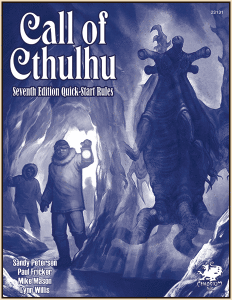
Call of Cthulhu 1920’s isCthulhu Chaosium a historic horror RPG that focuses primarily on story, investigation, and role-playing.  It’s not very combat-oriented (Most of the monsters will simply shatter your mind and eat your face.  So it’s best to avoid them directly).  It was exactly what I needed. 

The only problem I saw with it was that playing in a strictly Lovecraftian setting would quickly bore me.  I wanted to bring in The Mummy, The Shadow, King Kong, Tales of the Golden Monkey, Indiana Jones, and all the other 20’s and 30’s pulp adventures, as wells as some classics baddies like vampires and lycanthropes.  So again…Interlock Unlimited to the rescue.

It took me a few months to convert and write rules, but we now have a fully-functional game set in 1925.  I call it Pulp-Era Unlimited, but when people ask me what I play, I simply tell them Call of Cthulhu.  That’s a lot easier than saying that I play a home-made game inspired by Call of Cthulhu and Brendan Fraser movies that uses a fan-modified Cyberpunk 2020 rule system.

So there it is.  I’m a massive nerd.  I admit it.


-Seth


5 Lessons I Learned When Querying a Novel

Hi all,

Most authors will agree that the hardest part of writing a novel is getting a publisher to notice it.  This is usually accomplished by getting yourself a literary agent. But then the problem just shifts to getting an agent to notice your work.  Querying a novel to an agent or editor is an art.  It’s also hell.  A cold, horrible hell.

Dozens of sites and books are out there, all telling you how to query effectively.  A good query letter should sell the book, the main conflict, and hero’s goal in just 3-5 sentences.  This requires cutting out all the beautiful twists, subplots, characters, and everything else you love as the author.  Now you must trivialize that brilliant story you’ve spent months or years carefully crafting, and sum it up in the barest of ways, all while still trying to make it sound remotely appealing.  (Did I mention that it’s hell?)

I’ve queried two novels in my time.  The first was a failure. The second, Dämoren, was a success.  I submitted the first query for Dämoren on March 2, 2013.  In honor of its anniversary I want to share the lessons that I learned.


 5: Know Your Sub-Genre

Before you query an agent, you first need to be sure that they handle your genre.  They say you should look in a bookstore and see what section your book belongs in.  Dämoren is a modern-day fantasy.  So…Fantasy, right?  OK, that’s a start.  But then we get into the bizarre world of sub-genres.  Modern-day fantasy (or Contemporary Fantasy) can be broken into several categories, such as Urban Fantasy, Magical Realism, Paranormal Fiction, or Supernatural Fantasy.  This is before we even splinter it further into Young Adult, or Romance categories for each of those.  Some agents won’t handle Urban Fantasy, but will gladly do Magical Realism.   Some have Urban Fantasy listed on their website bio, but then somewhere else specifies that they’re strictly Young Adult Urban Fantasy. 

Amazingly, there is no standardized set of rules defining these sub-genres, and even worse, most agent websites will spend 95% of an agent’s bio page talking about their cats, but not really mention what specific micro-sub-genre categories they want or don’t want.  This means you will likely query an agent that doesn’t represent your sub-genre.  I actually found it easier to research most agents on sites that weren’t actually the agency’s website, just to find out what sub-genres they were looking for.

Once you figure out your specific sub-genre, and what agents represent it, list them on a spreadsheet.  Do this before you send a single query because…


4:  Organization is Critical

When querying my first novel, I queried every agency that I could find.  I have no clue who all I queried because I didn’t keep the best notes.  I shot queries out like Yosemite Sam shooting his pistols in the air.  After several months, it started getting harder and harder to remember who had and hadn’t rejected me.

yosemite-sam“Yee haw, I’m sending queries!”

Querying Dämoren was a different story.  I built a detailed and color-coded spreadsheet that listed which agents, agencies, and publishers I submitted to, what date I submitted, if any page samples accompanied the query, what their expected turnaround time was, and any other information I thought I might need.  I also listed the date I received a rejection.  This spreadsheet kept my sanity, which is good because…


3:  You Will Experience Horrible Self-Doubt

When writing Dämoren I received a lot of praise from my writer’s group.  It made me feel good. It pushed me to complete it.  Positive reinforcement from your writing peers is wonderful, but it doesn’t mean jack when the rejections start coming.  No matter how emotionless you try to be about it, that’s going to get to you.
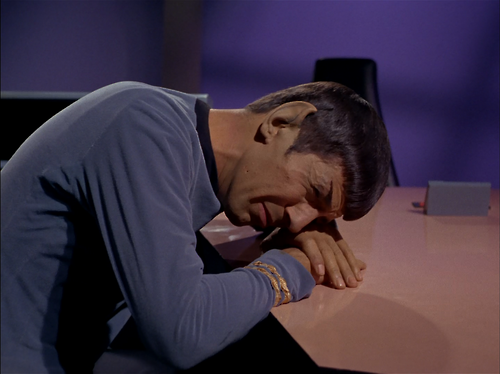
crying-spock“No one likes my book.”

At first I thought maybe my query letter sucked (which it did).  That’s a valid theory (because it did).  Two month into my query storm I attended the DFW Writing Conference.  There, I attended a workshop that taught me what was wrong with my query letter.  I rewrote it, and then submitted it for their Query Letter Gong Show.

The Gong Show is a fun little exercise the conference does where all the agents and editors attending get a gong, and anonymous query letters are drawn and read aloud.  Whenever an agent/editor hits the point that they’d stop reading the query letter, they hit the gong.  At the third gonging, the letter is discarded.  Afterwards, the agents tell the audience why they would have rejected it.  Also, since they’re up on stage, they want it to be entertaining as well as vent some of their exhaustion/frustration from being locked in a conference center for an entire weekend with 300 desperate writers, they’re pretty savage in their criticism.  Seriously, this is like American Idol, but they’re all Simon.  After the first few public eviscerations, I was horrified when they drew mine and began to read it.

Amazingly, no one gonged it.  Not only was mine the only query letter to make it through, it didn’t even receive a single gong.  I was cheered, applauded, blogged about (Here and Here), and told that I now had a perfectly crafted query letter.

Query Gong Show Victory“My query letter is victorious!”

Armed with the “perfect” query letter, I went on to receive 6 more months of rejections.  I also no longer had the excuse that it was my query letter’s fault that no one loved me.  Saying that this was a punch to the nuts for my self-esteem is a lot like calling the Polar Vortex a “slight chill”. It was crushingly depressing.

Just remember that you’ve got to muscle through it.  Start that next project to keep your brain occupied.  Make yourself write.  Writing the next project is better than just sitting around and waiting.  Especially since…


2:  Waiting Leads to Paranoia

Some agencies have a listed wait time of just a couple days.  For most it’s 6-12 weeks.  That’s a lot of time to sit around and wonder.  After a while, you start to worry. “What if they didn’t get it?”  “What if it ended up in a SPAM folder or I sent it to the wrong email?” These questions gnaw at you.  They keep you up at night.

Most agencies forbid follow-up emails.  I’m sure they get hundreds of them anyway.  Still, you don’t want to ruin your chances by nagging them, and a simple “hey did you get it?” might just cause them to delete your message and cast you into the pit of rejections.

Rejected“This…is…REJECTED!”

This means all you can do is just stalk Query Tracker, and check your Spam box in case your reply ended up in there.  During my nine months of querying, I checked my Spam folder daily.  It got to the point that I knew the names of those penis enlargement and cheap meds swindlers more than I knew my own friends.  And for all my efforts scrolling through thousands and thousands of Lottery Winner Notifications and desperate pleas from the Nigerian Royal Family I found exactly zero agent emails.

In fact, I didn’t get that many emails at all. Which leads us to…


1:  Closure is Better Than Rejection

It’s hard to imagine, but there is a fate worse than rejection, and that’s not receiving anything at all.  Literary Agents get flooded with thousands upon thousands of queries (and yes, most are terrible).  This never-ending river of hopes and dreams from prospective writers leaves many agents too busy to take the 4.68 seconds to hit “Reply” and paste in a standard form rejection from a bounce-back mailbox.  How many agents do this?  About 50%.

Exactly one half of agents sent me rejection letters (including the one that came in an envelope that I had stamped and addressed myself when I submitted it.  So it’s like giving yourself bad news.). The other rejections came in the form of silence.

The silence is worse than anything.  You will spend weeks wondering, praying, hoping that they just haven’t accepted you yet.  This tiny thread of hope is worse than any rejection notice.  A rejection means closure. It means you can move on.  Silence is forever.

And don’t think that if an agent requests pages from you that it gets any better.  It doesn’t.  I had several agents request pages.  One requested the first 50.  Never heard from him again.  Another requested a full manuscript.  No reply (I later found out she had left the agency).  Another requested 50 pages, then the manuscript, confirmed she had it…then nothing.  To be completely honest, I’d rather have had a cruel, hateful, whiskey-fueled rejection than the pain of not knowing.

Your Manuscript Sucks.  Thank you for checking“Dear author, after careful consideration we’ve decided that your manuscript is fucking awful.
You will never have any future in this industry and should probably hang yourself.
Thank you for giving us this opportunity to witness the worst writing imaginable.
Please lose our email address and die.”

At the DFW Writers’ Conference I listened to a panel on ‘Finding an Agent’.  It was hosted by two agents that spent half an hour sharing the secrets to win their hearts.  Their suggestions started out pretty standard.  Look up the agent first.  Be sure they represent your genre.  Address the query to the agent by name, and if possible, list a reason why you chose them.  The agents then went on to suggest that writers go to their local bookstore and look over the books that those agents represented.  Mention those books in your query.  Compliment them.  Tell them they’re great, but don’t overdo it.  This research of scouring bookstores should take at least a day per agent.

Later, they revealed that one of them did send rejection notices, while the other proudly stated that she did not.  So even though she wants you to physically drive to a store and spend 1-2 days researching her work in order to craft her a custom ego-inflating query letter, don’t expect a simple “No thanks, but this project isn’t what I’m looking for.  Good luck in your endeavors.”  That message will never come.

Just accept that this is part of the business.  If an agency says their turn-around time is 8 weeks, then unless you hear otherwise from them, after 8 weeks mark that query as “rejected” and move on to the next.

In the end, querying is just a part of writing.  We face the trial by fire and survive it. When you see all the thousands of titles filling a bookstore, just remember that every author there has endured what you are going through.  They know what it’s like.  They want you to succeed and to join them.  You just have to survive it.  It gets better on the other side.
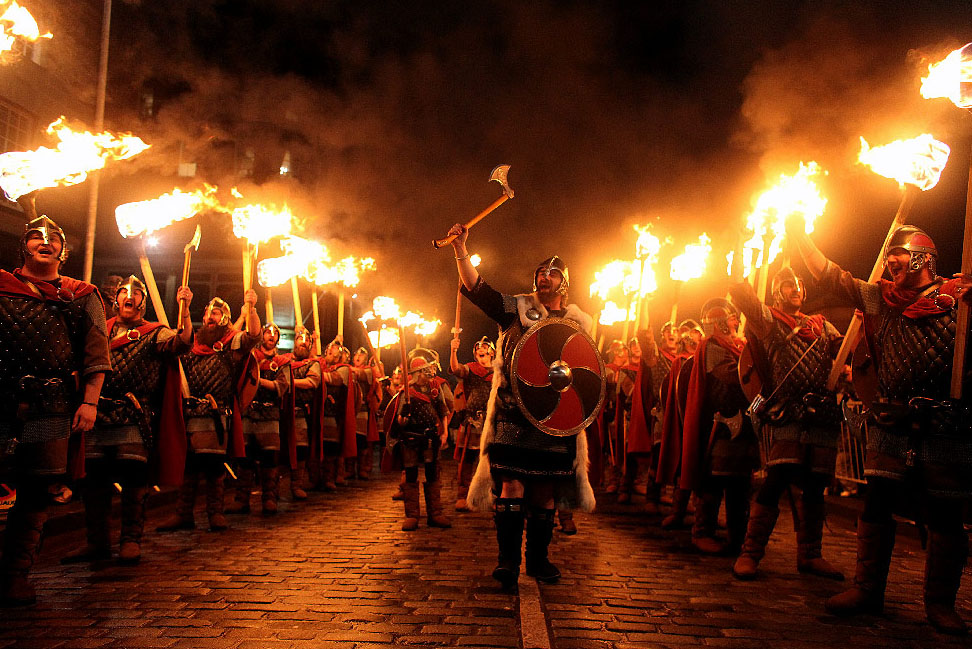
Welcome to ValhallaThe other side is Valhalla, BTW.

 And just in case you’re wondering how many rejections your favorite authors received, check out LiteraryRejections.com

 -Seth


“Lo there do I see Tolkien. Lo there do I see Howard, Jordan, and Rowling. Lo there do I see the line of my genre, back to the beginning. Lo, they do call me, they bid me take my place among them, in the halls of Valhalla, where the published may live forever.” ~  Genre Viking

Black Raven Revealed – February in Review

Hi All,

Well, the past few weeks have been extremely busy.  I’ve gone through a couple rounds of Dämoren revisions, and she’s looking pretty good.  There’s more editing and changes left to do, but it’s coming along very nicely.  Of course, novel revisions have eaten into a lot of my normal writing time, but I still found time to knock out Chapter 5 of Hounacier.  I’m about 25% through the first draft, so I’m pretty excited to see it shaping up.

But what gets me the most excited is this…

MOD - Cover artHiya, handsome

That, ladies and gentlemen, is the cover art for Mountain of Daggers, and I think artist Didier Normand did a fantastic job.

Ahren looks great, and that Tyenee pendant…wow.  I mean…WOW!  I love it.

I’m already discussing with a couple places the details for having that pendant made for real.  I can almost promise that myself and my editor, Jason Waltz, will be getting one.  That medallion is just too pretty not to exist.  Pricing, of course, will determine if other medallions will available, and if so, expect some contest prizes. 

The picture seems to be cut off though, doesn’t it?  What’s Ahren doing there?  What’s in his hand? If only the picture kept going, maybe wrapping around the rest of the book, we could see what he’s up to.

Oh wait, never mind, it totally does…


Mountain Cover 1st DrIs just a few short moments, three people will need to roll some Saving Throws


That picture makes me happy.  It makes me very, very happy.  I want to thank Rogue Blades Entertainment and Didier Normand for making that picture a reality. 

The last update I can give for the month is that last night I outlined my next Black Raven adventure.  Very Lovecraftian.  I can’t wait to start writing it out.

-Seth


Story Inspirations – Florence

Hi all,

As I’ve written before, every author can name specific things they’ve seen, or read, that eventually appeared in one of their stories.  One city that has, and will continue to inspire my writing, is Florence Italy.

Florence

My first trip to Florence was in 2006, then again in 2012.  It is a beautiful city, brimming with history.  So much of it has appeared in my Black Raven stories, but the majority is simply atmosphere.  However, I did get a few pictures of some of the specific things that have directly influenced my writing.


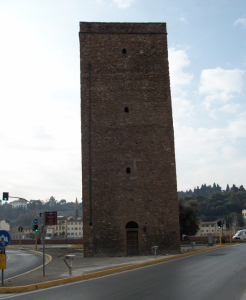
TowerLonely Tower:  This tower was once part of the city walls and housed the mint.  Now it stands alone on a little island in the street.  Its imposing walls, and the difficulty I imagine in trying to break into a building that is so out in the open, led me to use similar buildings in both Darclyian Circus, and City Beneath the Kaisers.


Michelangelo's TombMichelangelo:  It’s impossible to spend any time in Florence without seeing Michelangelo’s influence.  He was so popular in his time, that the Pope more or less forced Michelangelo to work commissions for the church.  The idea of an artist held prisoner is what inspired The Gilded Noose.


LocksLockLock Clusters:  On and around the Ponte Vecchio bridge, there are thousands and thousands of padlocks affixed to just about everything.  The local legend is that lovers who affix a lock to the bridge, then throw the key into the River Arno, will have good luck.  I used these locks in Dämoren.


PerseusPerseus with the Head of Medusa:  Benvenuto Cellini’s (the guy whose bust is surrounded by locks above) beautiful sculpture captured my imagination when I first saw it in 2006.
I’ve always loved the Perseus myth and used the story in Dämoren. Later, I decided to give the statue a brief cameo in my novel.


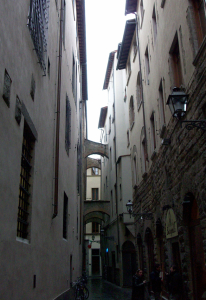
Florence StreetsRoofs Along Narrow Streets and Alleys: My love of rooftop chases is older than I can remember. I’d already used the idea in The Mist of Lichthafen before I’d ever made it to Europe. Later, when I actually saw how close the rooftops actually were, and the support arches between buildings, I knew that it wasn’t just fantasy. Since then, my heroes have hopped rooftop to rooftop in several stories, most notably, Thieves’ Duel.

Alleys are one of my guilty pleasures.  When other tourists are snapping pictures of beautiful churches and great artistic achievements, I’m creeping though the narrow alley across the street. Florence is centuries old.  It’s endured wars, plagues, riots, and all kinds of other nastiness.  There’s no inch of the city that isn’t history, and for some reason, alleys are where I can really feel it.  More than once, my wife has turned around from something beautiful to realize that I’ve ducked off into some side-street to explore.


Narrow StreetThis alley is exactly one Seth wide

 I’ve heard many authors say, “Never stop writing.”  That’s great advice.  However, you do stop.  You go to work, you go out with friends and family, you get sick, you bingewatch Downton Abbey.  You might stop for only a few hours or days, but you do stop.

Because life happens, my secondary advice is, “Never stop drawing inspiration.” When you’re not writing, you’re still researching.  Maybe not consciously, but you are.  Keep that little recorder going in the back of your head.  Note smells, sights, and the way things make you feel.  Keep them in your mind because once you do return to your writing, you’ll have them waiting for you.

Writing isn’t just sitting in front of a computer, pounding out page after page.  Writing is teaching yourself to record the world in ways that can be told to others.  You don’t just look at a picture to draw your inspiration.  You note the frame, the wall behind the picture, the sounds of the room the picture is in, the hall that led you to it. Being a writer is being able to remember all those little details, the emotions they conjured, and letting your imagination run wild with them.

Never stop drawing inspiration.

-Seth

3 Origin Stories They Totally Dropped The Ball On

Whenever we’re introduced to a great an interesting character in a movie or TV show, we want to learn more about them. How did they get that cool?  Why are they so evil? What’s up with that hair?  So our favorite writers will sit down and toil away for hours/months/years to craft a beautifully fitting and awesome origin for these characters.  Other times, they just puke something out, hand it to us, and cash their check.  Below is a few of those.

(Warning: Spoilers of old Movies and TV shows)


3 – Anakin Skywalker
You should have seen this one coming.  How could you not?  When George Lucas told us that he was going to reveal the story as to how Darth Vader got so evil, and so damned mysterious, the Nerd World was literally lining up to hand him our money.  This is the same guy that beautifully explained that Indiana Jones became such a badass guy because his daddy was James-Freakin-Bond, and his fear of snakes was because of a circus train mishap while he was being chased by his future alter-ego, oh, and Indiana was the dog’s name.  Brilliant!  And now that same beautiful mind will tell us how a young Jedi became Thulsa Doom. (Author’s Note:  If you understood incoherent rambling above, you’re my people.)

Instead of awesome, we got this:

AnakinAnd the Nerd World wept.

After Qui-Gon Jinn’s SR 71 Blackbird spaceship lands on Tatooine, they meet little annoyingly cute Anakin Skywalker whose force-power is through the roof.  When they ask his mom who this kid’s dad was, she said he had no father.  This leaves us to believe one of the following…

1: She’s lying and is ashamed of the father’s identity (I’m guessing Watto)
2: She was impregnated by a swarm of midi-chlorians (They swarm, right?)
3: This is a virgin birth and Anakin is Jesus.

Younglings DieWWJD?  I’m guessing not murder a room full of cute kids.

Why it Sucks:
There is no need for a mysterious origin like this.  If Lucas wanted to say that there was something more at play to a random slave child on a back-woods planet to be the most powerful Jedi in the world, he could have given us more. 
Fans have theorized that Anakin’s origin was the clever manipulation of midi-chlorians by Darth Plaugeis, but that’s just a fan theory to explain the unexplainable.  Now we’re to believe that the already ridiculously elaborate plan of Darth Sideous to get himself on the Senate included the part where they stop for gas on Planet-X and happen to pick up a child that they will bring home for him to corrupt.
Lucas could have had Anakin’s mom be impregnated by a mysterious man that came out of the desert and loved her for one night, or a mysterious man with a hypodermic needle, or she was on a medical ship that crashed on Tatooine and was sold into slavery and has no idea what experiments were done to her, but 9 months later Anakin came flying out.  Those then lead to further questions and more mystery and not some goofy, “I swear I’m a virgin” excuse.


2 – Starbuck.

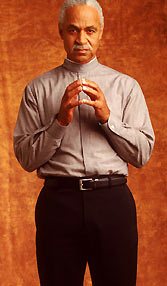
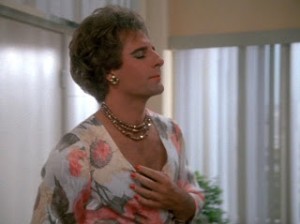
DirkBenedict - StarbuckNo, the other Starbuck.


Starbuck-KaraYep, that Starbuck.

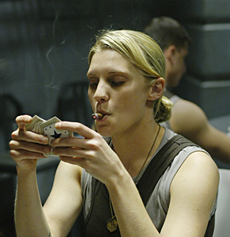
The reboot of Battlestar Galactica turned a fun and cheesy 70’s sci-fi show into a kickass series filled with intrigue and commentary on current events.  Among the cast is Kara “Starbuck” Thrace.  For most of the show Starbuck is a cocky, overconfident, emotionally damaged, extremely religious, very artistic, likely an alcoholic, badass.  We loved her.  As the series goes on, and the Cylons begin revealing themselves, we learn of the #7 model, Daniel.  We never meet this Daniel, but learn that he was a very artistic model, and that he and his entire line (of very religious robots) are dead and the Cylon ability to regenerate (come back from the dead) won’t even work on him.

Meanwhile, Starbuck dies.

Never mind, she comes back in a brand new Viper, that’s just like her old one, but not.

Logically, everyone believes Starbuck is a Cylon.  But then we learn that she’s not.  Then we have flashbacks of her dad, a musician that’s been dead now for several years.  Her dad teaches her a little song that also just so happens to be the key coordinates to Earth, a song that the half-breed Cylon child of Athena and Helo also knows.  At this point, everyone has come to one of two conclusions.

1: Starbuck’s piano-playing father is this Daniel guy who made a unique model (Kara) and Kara is a Cylon (or half-Cylon) and she has the ability to regenerate somehow.  Maybe before Daniel died, he gave her all the clues in her databanks and that’s where all her visions come from.
2: Kara is Daniel in a different body.  She’s created her own regeneration ship that’s been following the fleet and she and has learned the key to Humanity’s salvation.

In the end we learn that neither are true.  Kara is an angel (or something) and in the last few minutes she vanishes into thin air.

Why it Sucks:
Fraking angel!
Seriously? After all the good writing and twists and turns, we have Starbuck just vanish for no real reason? I have no problem with there being angels on the show. They already had two of them. But neither followed the weird incoherent rules of the Starbuck Angel (such as being corporeal and killing things). The Starbuck explanation was terrible writing in an otherwise great show.


 1 –  Shepherd Book.

BookBadass space-preacher

Out of all the great characters in Firefly, the most mysterious was by far Shepherd Book.  At first, he’s this nice priest that ends up on a crew of smugglers, fugitives, and Jayne Cobb (which is a classification unto itself).  As the series progresses, we start learning little tidbits about our good Shepherd, such as his in depth knowledge of the criminal underworld, master proficiency with military weaponry, and one freaky moment when psychic River sees him being all kinds of sinister beneath his normally sweet facade.  At one point, bounty-hunter Jubal Early mentions that Book, “ain’t no Shepherd.”  The biggest mystery, however, was when Book was shot, and the desperate crew brought him to an Alliance ship for help.  The captain was about to dismiss Book to go off and die, but then sees Book’s ID card, craps himself, and gives Book the best medical attention the future has to offer.  Why would they do that?  Then the show ended and he Nerd World wept.

Then the movie “Serenity” comes out.  In it, we learn two things:

1: Book knows a hell of a lot about super-secret Alliance spies.
2: Book won’t reveal his past and it will forever be a mystery (and the Nerd World wept.)

And that was it…until…

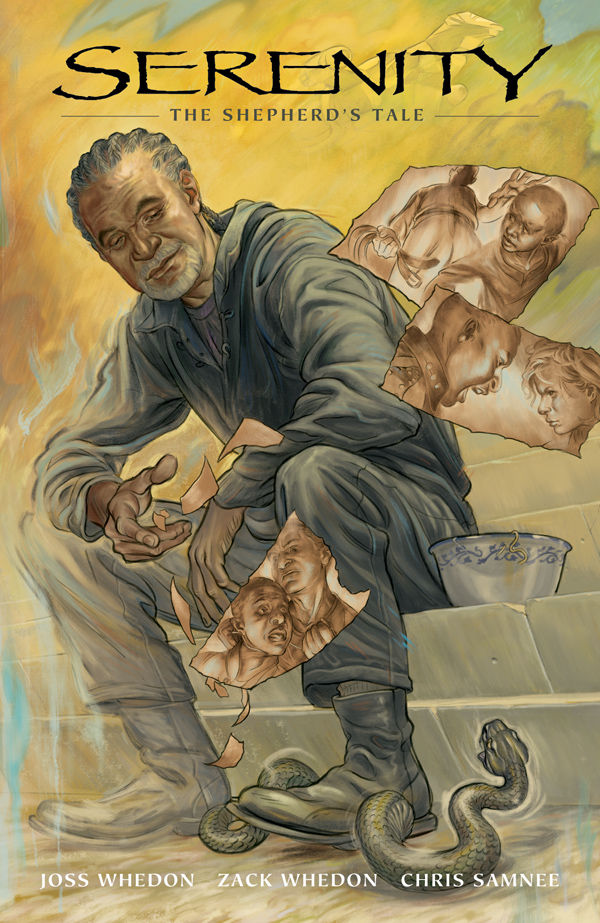
TheShepherdsTale-CoverSeriously, if you have not read this, do not keep going.

In this origin story comic book, they just couldn’t leave well enough alone and decided to reveal who Book really is.  In short, Shepherd Book is a super-elite Independence Movement spy that infiltrated the Alliance, worked his way up in the ranks until he could sabotage it from the inside.  He was responsible for the “single greatest disaster in Alliance history” in which thousands of people died.  Disgraced, he was politely asked to leave the service by being shout out of his ship in an escape pod.  Eventually he found God, joined the Monastery, and then wandered onto Serenity.  Oh, and he has a bionic eye and his real name isn’t Book.

Why it Sucks:
OK, so if Book was a disgraced Alliance Officer that was responsible for the “single greatest disaster in Alliance history,” why would an Alliance captain even bother to fix Book’s injuries?  He wouldn’t.  Book was dishonorably discharged out of an escape pod.  They don’t care if he dies.  They WANT him to die.  This makes no sense.  Also, it’s just too easy that Book was a super-spy for the good guys.  This was a cop-out.

There are dozens of fan theories out there as to who, and what, Shepherd Book was supposed to be.  Here’s mine: Shepherd Book was Alliance.  Possibly high-ranking officer or even an Agent.  Book is hailed as a freaking hero because during the Rebellion, Book was instrumental in the victory at The Battle of Serenity Valley.  He won the war.  However, the carnage and death he witnessed was too much for him and he faded off into obscurity.  He found God, joined a monastery, and then finds himself on a ship captained by a man that lost his own faith in God when his men died at the Battle of Serenity Valley.  Book sees this as a sign, and the reason he stays on the ship is because he believes that the key to his salvation is to restore the faith to the man he stole it from.

Now imagine that the series was never cancelled.  Now imagine the conflict that would occur when someone found out that sweet Shepherd Book was responsible for all the mental anguish that Malcolm and Zoe endured.  Imagine what they would do if Mal or Zoe found out.  Beautiful, isn’t it?

Unfortunately, they went with the bionic eye story, instead.

Editing and Ice: A Summary of my January

Hi all,

The past month has been eventful.  Hounacier is coming along quite nicely.  I’ve broken the 20,000 word mark and am plugging away at a good speed.

Early in the month, Old Man Winter blessed our house with this little present.

StupidPipeBurstThe pipe says:  “Boooooshhhh!”

 It might not look like much, but that teeny tiny hole was quickly able to turn our downstairs into a small lake.  Fortunately, my wife was home at the time it blew, otherwise it might have destroyed our house.  The pipe itself went to an outside faucet, and yes, I had put one of those insulated covers on it.  The problem was that the people who built our home never really considered the possibility that Texas would get that cold, so they were a tad lax on installing anything that resembled wall insulation.  (It was the 1980’s then, a strange time when bathrooms were carpeted, and insulation was just a suggestion.  Both those issues have now been addressed.)

Dämoren revisions are underway.  So far, we’ve trimmed over 2,000 words.  Right now I’m just waiting for the next round.  Most authors I talk to really hate the editing process.  Not me.  I dig it.  My reasons for that could fill an entire blog post (Note to Self: Write a post about this), but the short of it is that stories look better after they’re professionally edited.  Yeah, it can hurt some, but so can all sorts of other things we do to make ourselves presentable.  I trust Tim Marquitz, and together we’re going to clean her up and make her shine.

The cover art for Mountain of Daggers is just about finished.  I saw it last week and absolutely love it.  There was just one minor change I requested before it’s complete.  Hopefully, I’ll get permission to share it soon.  Mountain of Daggers has been a long-time coming, and seeing the art actually gave me chills.  The focal point of the cover is a pendant depicting a mountain made of upturned daggers.  Seeing that symbol (drawn well, and not my own terrible sketches) was by far the greatest part.  There is a slight (98.42%) chance that I may have a pendant made for myself.

All in all, it’s been a good month (Except for that broken pipe part.  That part sucked).

-Seth


The Best Writing Resource I’ve Ever Found

Hi all,

Whenever I talk to someone who has either just started, or is considering writing, I always point them toward the website that has helped me more than anything else, The Online Writing Workshop for Science Fiction, Fantasy, & Horror or simply, OWW.  Now, of course, the budding author needs to be working in one of those three genres, but that’s usually the case with the circles I run in. OWW

I’ll go ahead and state that I am not paid or profiting in any way by pimping this site.  I’m just a very satisfied customer.

I stumbled across this website right when I was first starting out, and I’ve been a huge fan of it ever since.
How it works:

  • You post a short story/chapter/etc. of 7,500 words or less.
  • Other authors from across the globe will read your submission, and critique it.
  • In order to post more submissions and receive more critiques, you must critique other authors to “earn” the points to post.

It’s a simple formula, but it works. Here’s why:

  • The reviewers are not friends. I love my friends.  My best friend reads everything I write before anyone else in the world gets to.  But most people can’t give true feedback to a friend.  They love you, and their personal bias allows much more forgiveness for weak writing.  Now some reviewers might become your friends.  I have several crit-buddies that I’ve met there, but whatever friendship we now have is founded on our ability at brutal and blunt creative honesty.
  • The reviewers are writers. A writer can look at a story and see it differently than a non-writer can.  They can identify clunky phrasing, word-abuse, and overall flow much better because they’ve trained themselves to see it in their own writing.
  • The reviewers, like your eventual readers, have only the work to go on. The biggest disadvantage my wife or my friends have when reading my drafts is that they already know part of the story.  I’ve told it to them, and bounced ideas.  Their judgment of how I set up a scene or plot-point is now based off of those conversations and not exclusively on the written work.  The reviewers on the workshop have been spared from those spoilers and their impressions are more valuable for it.
  • The impersonality of the Internet allows for honesty. I’ve been to face-to-face workshops or writing groups and the average person is simply a lot more honest with delivering criticism if they don’t have to look you in the eye when they give it.  Furthermore, the inability for the person receiving the criticism to interrupt, defend, or react, allows for more brutal truth.
  • Learning to review other writers teaches you how to review yourself. When I first started the workshop, I’d have writers point out flaws that I just didn’t believe I had.  Then, after reviewing other authors, and honing my skills, I started to make those exact same comments to others.  Then it hit me.  “Damn, I’m guilty of it, too.  I see it now.”
  • The variance of reviewers allows you access to their experience. This is one of those hard-to-identify benefits, so I’ll give you a few examples.  I’ve read stories by people that clearly have limited or zero experience with shooting a gun.  It’s not that they say anything wrong in their writing, but that it lacks anything above what you find in movies (particularly how loud they really are, or how far white-hot brass can fly and the fun places that it can fly into.)   Having a reviewer suggest little details that can add to the realism not only makes it read better, but can give a lot of credibility.  Personally, when writing DÄMOREN, I was fortunate enough that out of my small circle of reviewers I happened to have a Filipino author that could verify if I’d used an Aswang correctly.  I also had a British author. She helped me with Allan’s dialogue.  Another reviewer grew up in Tuscany, and they were able to help with the little details an actual resident would know over my short experiences there as a tourist.  That’s a much larger diversity pool than I’d likely find at any local writing group.

With any critique, you’ll need to learn what to follow and what to ignore.  That’s just a fact of writing.  I don’t always follow the advice of my reviewers, but I do note it.  If more than one person mentions the same issue, it might be something that does need correcting.  Honestly, I’d rather have 100 scathing peer reviews of an unpolished piece over an editor’s rejection of a finished one.  Most editors won’t tell you why they reject a submission, and having other authors tear it up first can greatly improve the chances of having a story accepted.

Now, not every review is a “good” review.  Occasionally you get one that is just useless.  Every once in a while I’ve had a writer show up that gives crits that are either pointless, or insane rantings.  But those are the minority.  Honestly, in the hundreds of reviews of gotten there, I’ve had less than 15 completely useless ones. Some might be 99% bad, but then they find a typo or make a style/story suggestion that no one else saw.  That’s still a “good” review.

So for any new writers needing a place to hone their craft, you should check it out.  There are other online workshops out there, and some of them are reportedly pretty good.  But this is the only one I’ve ever used, and I can honestly say that it’s where I learned to write.

-Seth

How I Learned to Stop Worrying and Love the Book in a Drawer

Back when I first started writing, I penned an amazing dark-fantasy called Dreams of Lost Souls.  It was the first of four in my Empire of Deceit series.  Coming in at 114,000 words, it took me just over two years to write.  Once finished, I immediately started on its sequel, Divine Liberation, while simultaneously trying to pitch the first book.

I attended a writer’s conference in Austin Texas, and learned how to query and pitch my masterpiece.  While there, I heard several authors and editors all lovingly discuss their books in a drawer.  For those who don’t know the term, a Book in a Drawer is an unsellable manuscript that never sees print and spends eternity living in a drawer (or in today’s case, on a hard drive).  Evidently, most authors have a cherished work that they keep hidden away (some authors have several).  They’re considered “practice novels.”

“Fools,” I thought.  “I’m not going to have an entire book that never gets published.  I’m going to sell this baby, and then I’m going to sell its sequels, spin-offs, movie rights, and have to buy a new house just to hold all the awards they’re going to earn.”<insert evil laugh>

No one bought it.  No one even asked for a full manuscript.  I wish I could tell you how many rejections I got, but I can’t.  I just stopped counting.

rejectedI found it to be a lot easier if I just stamped them myself.

But that didn’t stop me.  I kept writing.  I kept editing. I kept writing short stories that all took place in the same fantasy world I had written.  (The concept was to create a living world that has many stories and adventures going on, not just the one epic tale)

After several more years, I found myself at the FenCon 2011 Writer’s Workshop.  It was chaired by Editor Lou Anders, who had just won a Hugo.  It was going to be 3 days of peer reviews and one-on-one with one of the industry’s rock-stars.  I knew that once he read the first 10 pages, he’d be sold.

He wasn’t.  In fact, he tore it to Hell.  I was over 200,000 words into my series, and spent three days having Lou (who is a terribly awesome guy, by the way) patiently, but brutally explain that it was sheer crap.

Some of the other authors were understandably upset having their works shredded.  Strangely enough, I wasn’t upset at all.  I was relieved.  It felt like a huge burden had been lifted off my shoulders.  I not only knew my book was bad, I knew why it was bad.  I knew why theirs were bad.  And most importantly, I knew what an editor was looking for.

The final morning of the convention, I saw Lou quietly having breakfast.  I stopped by to thank him for all his help and tell him that he’d given me the courage to put my manuscript away and finally start on a story idea that I’d been bouncing around for the past few years.  Not wanting to be a bother, I tried to make it a real quick conversation.  Lou (I can’t stress enough what a nice guy he is) asked me to sit and we then just B.S.’d for half an hour.

When I told my wife that I’d finally given up on ever selling Empire of Deceit, she was horrified.  She thought I’d be crushed.  I simply told her that it was my practice novel, and it had taught me how to write.

The next week, I started Dämoren.

I met Lou again at an Agent/Editor Conference in 2013 while hocking a freshly-finished Dämoren.  I thanked him again for giving me the courage to start this new project.  We talked shop for a bit, then snuck off, grabbed a coffee, and discussed important matters like Batman and Sci-Fi TV shows.

My name is Seth Skorkowsky and I have a book in a drawer.  No you can’t read it.  But my novel Dämoren is about to be released by Ragnarok.  You can read that, instead.

Oh, and as far as those short-stories that took place in the same fantasy world as my never-to-be-released novel: You can check out The Mist of Lichthafen, Relàmpago, or my soon to be released Black Raven Series.

So for any aspiring novelists reading this: Good luck.  I hope you sell your first novel and fill a money bin with all the fortune you deserve.  I really mean that.  I’ll also hate you with jealousy, but it will be a loving hate.  However, if you don’t sell that first novel, don’t worry, you’re in good company.

ducktales-money-binI hope this is you.

-Seth

Adventure of the Week TV

Hi All,

One thing that’s been bothering me with television the past few years is that the old, “adventure-of-the-week” shows are just about gone.  What I mean, is those fun shows that rarely required you to see the previous episode in order to understand/enjoy them.  Instead, TV has become full of soap-operas where each season, or the entire series, is one linear story, forcing the viewers to watch every single installment, fearing that missing one will cause chaos and confusion forever.

Lost-season1The title reflects how you’ll feel if you miss a single episode.

The adventure shows I’m referring to are shows like, MacGyver, Magnum P.I., Quantum Leap, Highlander, and, of course, Star Trek.

These were shows that you could catch a random episode, having little to no experience with the show, and quickly understand what’s going on.  The heroes are not necessarily law-enforcers, they’re usually good guys that operate outside the law (The Equilizer, The A-Team, Firefly), agents of a secret government program (X-Files, Mission Impossible), or maybe explorers or lawmen out on the dangerous frontier (Star Trek, 85% of all Westerns).

These days, most shows that follow the adventure-of-the-week theme are Cop Shows, usually police procedurals, or Sitcoms.  No one needs know what shenanigans happened last week on Two and a Half Men in order to enjoy this week’s episode.

Now, don’t get me wrong, I love me some Game of Thrones, Breaking Bad, and Battlestar Galactica.  There’s nothing wrong with a series.  I just miss when TV had short stories, too.  Personally, I blame Lost.  Lost taught the networks that you could literally throw anything up on screen with the most convoluted plot ever, and as long as you hooked them with drama, and mystery, and a glimmer of hope that it would eventually make sense, the addict viewer would come back for more every week.

Quantum Leap had a great gag to hook their viewers.  Every episode would end with a little stinger for the next one.  Usually awkward.  Sam would leap into his next body, and suddenly figure out that he’s a teenage girl, or Elvis, or holding a bloody knife above a corpse.  You’d see his “oh no” face, then cue credits.

What-Price-Gloria_Quantum LeapThey just don’t make TV like this anymore.

Sometimes, an adventure-of-the-week show becomes a series.  Those also disappoint me.  Burn Notice was a great pulp show, sort of like The Fugitive meets, MacGuyver.  Then it became a linear story.  Supernatural was the same way.  At first, our two roguish monster-hunters killed a new baddie every week, deliver some clever banter, then drive off in their muscle car blaring some rock and roll, headed toward next week’s adventure.  Then it became an elaborate storyline involving Badger from Firefly and Booger from Revenge of the Nerds.  A good indicator that your show is becoming a series is if the opening regularly includes a narrator/character saying “Previously On,” followed by a montage.

Castle was a great adventure of the week show.   I loved it.  It was like Murder She Wrote meets… meets Nathan Fillion.  I’ve missed the last season or so, but have been informed that its weekly antics have switched to a longer story-line.

Now the purest of the short-story shows were the ones that were individual stories (Outer Limits, The Twilight Zone, Alfred Hitchcock Presents, and Amazing Stories).  Those shows were wonderful (OK, Amazing Stories was actually pretty damn cheesy).   They tried rebooting Twilight Zone a few years back, but not even the power of Forest Whitaker could save it.

I suspect the reason for the shift in formats comes down to two big factors.

  1. Viewers that aren’t hooked might stray.  There’s just so many shows out there, and unless a show holds the plot resolution captive, viewers might not tune in next week.
  2. Crappy Writing.  Writing a new story can be hard.  It’s especially difficult to pump out 13-15 new stories every season (remember back when a season was 20+ episodes?). So let’s just take one story and stretch it out.  Problem solved.  Now, instead of needing to have a beginning, middle, and end like every other story written since the beginning of time, TV writers just have to come up with enough to keep you interested (see Lost).

Hopefully, one day an adventure of the week show will appear that will blow everyone away.  Then maybe studios will begin swinging back toward that format. Until then, we’re all pretty much stuck with soap operas pretending that they aren’t soap operas.

-Seth